Origins
Where does it come from?
Descended from terriers of British origin, the Australian Terrier was developed in Australia from imported dogs such as the Skye Terrier, the Scottish Terrier, the Dandie Dinmont Terrier and the Yorkshire Terrier. The first dogs close to the current standard appeared at the beginning of the 19th century, especially in Tasmania. A working breed above all, it was used both to hunt vermin and to raise the alarm in the event of an intrusion.
Appearance
What does it look like?
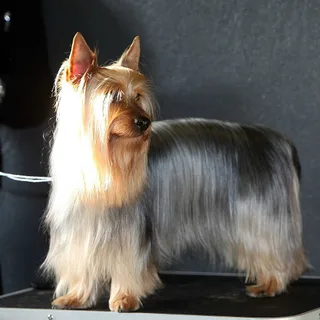
The Australian Terrier is a small dog low on legs, solid, rustic and full of vigor. Its body fits into a rectangle, with a horizontal topline, a strong loin and a moderate chest. Its coat is dense, straight, relatively long and of harsh texture, with a short and soft undercoat, a ruff on the neck and a topknot on the head. The ears are small, erect and pointed, the dark brown oval eyes express great liveliness.
Temperament
Temperament and personality
Hard-working, determined and hardy, the Australian Terrier retains a true terrier temperament in a compact format. He is affectionate with his family, pleasant to live with and generally well-balanced. His natural alertness and energy make him a lively companion, without being an imposing guard dog.
Living together
Living with children and animals
Active on a daily basis, he needs frequent outings, games and interactions with those close to him to stay comfortable in his paws. He adapts to different lifestyles if his needs for activity and attention are respected. His terrier instinct can encourage him to explore, to chase small animals and to use his voice depending on the context.
Training
Training and socialization
His training must start early, especially for recall, self-control and the basics of obedience. The Australian Terrier learns well with a gentle, consistent and encouraging method, but he also requires a clear framework and a certain firmness. Short, playful and regular sessions generally give the best results.
Budget
Australian Terrier price & budget
The purchase price varies depending on the quality of the lineage, the seriousness of the breeding, the tests carried out on the breeding dogs and the availability of the breed. The overall cost is not limited to the acquisition and must be considered over the dog's entire lifetime.
View cost breakdownHealth
Health at a glance
The Australian Terrier is a small dog that is generally hardy and robust, but like many terriers it is not free from hereditary or orthopedic predispositions. Regular veterinary follow-up, good oral hygiene and maintaining a stable weight help to preserve its quality of life.
Prevention & watch pointsDiet
Feed it well
The Australian Terrier needs a complete, digestible and good-quality diet, adapted to its age, its weight and its activity level. Regular meals and control of intake are important to maintain a harmonious silhouette.
Our feeding adviceDid you know?
Anecdotes and popularity
The Australian Terrier is one of the rare breeds truly developed in Australia from British terriers. Despite its small size, it has long been appreciated for its hardiness, its determination against pests and its ability to quickly alert its household.