Origins
Where does it come from?
The Smous des Pays-Bas is a Dutch breed probably descended from the old yellow Schnauzer that appeared in the 19th century. It was mainly used in stables to hunt rats, mice and other harmful rodents. The breed declined sharply after the Second World War before being revived by Dutch breeders from the end of the 1940s and especially in the 1970s. The Hollandse Smoushond Club was founded in 1978 and the FCI recognized the breed definitively on 11 March 1981.
Appearance
What does it look like?
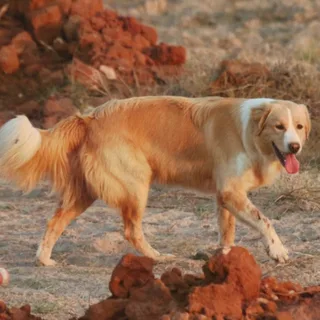
The Smous des Pays-Bas is a small robust dog, compact and powerfully built, without heaviness. Its body fits almost into a square, with an overall impression of vigor. Its 4 to 7 cm long coat is coarse, straight and wiry, with an undercoat present and a characteristic shaggy appearance. The cheeks have clearly visible moustaches and a beard, the eyes are round and dark, the ears small and drooping, and the coat is solid-colored in all shades of yellow, ideally dark straw.
Temperament
Temperament and personality
Alert, energetic and cheerful, the Smous des Pays-Bas is also very friendly, sociable and affectionate. He enjoys family life, is generally good with children and appreciates being close to his humans. Without being a guard dog in the strict sense, he knows how to raise the alarm when an unusual situation arises.
Living together
Living with children and animals
On a daily basis, this dog remains active without being hyperactive. He needs regular walks, interactions and a present family life to be well-balanced. At home, he is pleasant to live with and adaptable, but his past as a rodent hunter can resurface in the presence of small animals that he identifies as prey.
Training
Training and socialization
The Smous des Pays-Bas is a dog that is rather easy to train and to socialize. Docile, intelligent and eager to please, it responds well to consistent, gentle and playful training, with a small dose of firmness. Early socialization helps to channel its liveliness and to maintain its good relational balance.
Budget
Dutch Smoushond price & budget
The price of a Smous des Pays-Bas varies depending on the lineage, the seriousness of the breeding, the screenings and the socialization. The maintenance budget (food, veterinary care, training) often exceeds the purchase price over time.
View cost breakdownHealth
Health at a glance
The Smous des Pays-Bas is generally considered a robust dog, with solid health and good longevity. As with any breed, its condition depends on responsible breeding, an appropriate diet, a stable weight and regular veterinary follow-up.
Prevention & watch pointsDiet
Feed it well
The Smous des Pays-Bas needs a complete, digestible diet adapted to its small active size. The ration must take into account its age, its activity level, its body condition and the energy density of the chosen food.
Our feeding adviceDid you know?
Anecdotes and popularity
The breed is also known under the names Dutch Griffon and Hollandse Smoushound. Its historical link with Dutch stables and rodent hunting is part of its identity. Its tousled appearance, its yellow coat and its near-disappearance in the 20th century make it a breed that is both recognizable and quite rare.