Origins
Where does it come from?
The Affenpinscher is an old German breed whose ancestors appear as early as the 16th century in Albrecht Dürer’s woodcuts. The first records of dogs bearing this name date back to 1879. Developed at the beginning of the 20th century from wire-haired Pinschers, the breed then enjoyed great success. Selection gradually favored the black coat to the detriment of the other colors formerly observed. The Fédération Cynologique Internationale definitively recognized the Affenpinscher on 15 July 1955, under standard number 186.
Appearance
What does it look like?
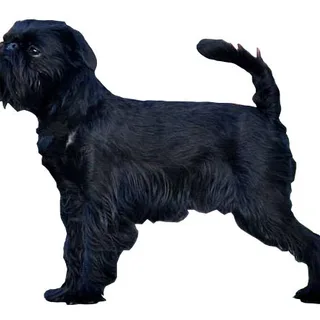
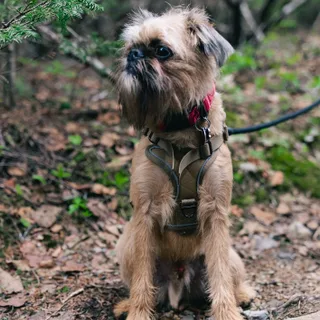
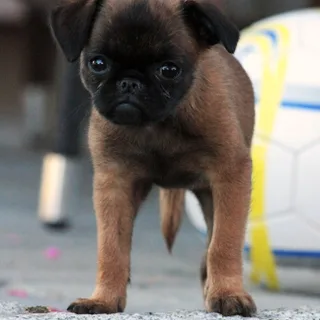
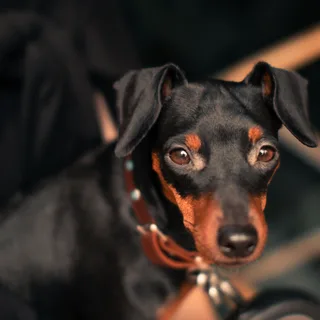
The Affenpinscher is a small robust dog, compact and built in a square. Its back is strong, short and firm, its loin short and solid, while its croup rounds slightly towards the tail set. Its round head shows a characteristic monkey-like expression, with a domed skull, a pronounced stop, a black nose and rounded dark eyes. Its small V-shaped ears are set high and point forward. Its harsh and dense coat, with an undercoat, forms on the head bushy eyebrows, a full beard, a topknot and side whiskers. The coat is entirely black and the tail is carried in a sabre or sickle.
Temperament
Temperament and personality
Alert, courageous, loyal and determined, the Affenpinscher is a vigilant companion who enjoys family life. He is affectionate with his own, playful and full of confidence despite his small size. His assertive temperament can nevertheless make him stubborn. Living with children requires caution, as this small dog does not tolerate being handled roughly.
Living together
Living with children and animals
The Affenpinscher adapts to different lifestyles, including apartment living, provided it enjoys daily walks and stimulation. It likes to run, play and explore without being an endurance athlete. A daily walk complemented by interactive games contributes to its physical and mental balance. Early socialization promotes good relations with its fellow dogs and other animals.
Training
Training and socialization
His training must be early, consistent and firm enough to channel his exuberance and his strong-willed side, without a power struggle. Short, regular and motivating sessions are better suited to his lively temperament. Socialization must begin from the youngest age in order to get him used to people, dogs, other animals and varied situations.
Budget
Affenpinscher price & budget
The purchase price depends in particular on the quality of the breeding, the lineage, the pedigree, compliance with the standard and the dog's intended purpose. The relative rarity of the breed in France can also affect availability and the price.
View cost breakdownHealth
Health at a glance
The Affenpinscher generally benefits from good robustness and sheds little. Its double coat protects it fairly well from cold and humidity, without making it suited to extreme climatic conditions. Regular veterinary monitoring remains necessary due to joint, bone and cardiac predispositions known in the breed.
Prevention & watch pointsDiet
Feed it well
The Affenpinscher needs a complete, digestible and precisely measured diet for its small size. The ration must take into account its age, its activity level, its body condition and any possible sterilization.
Our feeding adviceDid you know?
Anecdotes and popularity
The name Affenpinscher comes from German and evokes its little monkey expression, which also earns it the nickname Monkey Griffon. The breed is also known as Zwergaffen. Its silhouette and its very distinctive head were already depicted in Germanic art several centuries before its official recognition.