Origins
Where does it come from?
The Schipperke is a dog of Belgian origin, Flemish more precisely. Its name means "little boatman" in the local language, because it used to accompany boatmen. It is said to descend from the Leuvenaar, a very old breed also at the origin of the different varieties of Belgian Shepherds. Highly appreciated from the end of the 17th century in the Brussels region for its elegance, its vigilance and its ability to hunt pests, it was exhibited for the first time in 1882 in Spa. Its first standard was established in 1888 during the founding of the breed club.
Appearance
What does it look like?
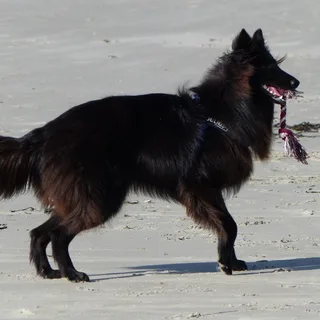
The Schipperke is a small shepherd dog of lupoid type, robust and well built, able to fit into a square. Its coat is exclusively black, very abundant, straight and dense, with a tight undercoat that gives it excellent protection against humidity and cold. It is distinguished by its ruff, its mane and its chest abundantly furnished, as well as by its small triangular ears standing well upright, its expressive dark brown eyes and its stocky silhouette without heaviness.
Temperament
Temperament and personality
The Schipperke is a lively, energetic, curious and very alert dog. Affectionate without being intrusive, it is appreciated as a family companion and generally proves gentle with children. Naturally wary of strangers, it has a good alert instinct and does not hesitate to signal any unusual approach. It also retains a hunter’s streak, notably towards small rodents.
Living together
Living with children and animals
The Schipperke adapts to different lifestyles provided it expends its energy daily. It can live in an apartment if its outings are sufficient, but it thrives more with a secure space where it can explore and play. Agile and enduring, it enjoys dynamic activities and games that call on its liveliness.
Training
Training and socialization
The Schipperke’s training must start early to channel its energy and set clear boundaries. Recall and early socialization are particularly important. With consistent and positive methods, it becomes a pleasant dog to live with, but its lively temperament requires regular involvement from the owner.
Budget
Schipperke price & budget
The purchase price of a Schipperke varies mainly depending on the quality of the breeding, the pedigree, the line, the dog's age and the availability of the breed. Beyond the acquisition cost, you must also factor in routine upkeep, veterinary prevention and accessories.
View cost breakdownHealth
Health at a glance
The Schipperke is an overall robust and resilient dog. Its double, abundant coat protects it well against cold and bad weather. However, the breed does have certain predispositions that should be monitored throughout life, notably on the orthopedic, ocular, endocrine and dermatological levels.
Prevention & watch pointsDiet
Feed it well
The Schipperke needs a quality diet that covers its needs in nutrients and vitamins while taking into account its age, its size and its activity level. As it can be prone to being overweight, its energy intake must remain well controlled.
Our feeding adviceDid you know?
Anecdotes and popularity
The name Schipperke means "little boatman", a reminder of its former closeness with Belgian boatmen. The breed was also among the favorites of Queen Marie-Henriette of Belgium. Its black appearance, its abundant ruff and the existence of individuals naturally without a tail or with a very short tail reinforce its singularity.