Origins
Where does it come from?
The Maltese Bichon belongs to a very ancient breed, known since Antiquity. Aristotle mentioned small dogs called "canes melitenses". Its name would be linked to the Phoenician term "màlat", meaning refuge or port, rather than to the island of Malta. Its ancestors lived around the ports of the central Mediterranean and on ships, where they hunted rodents. Highly appreciated by Roman ladies, then depicted in works by Rubens and Goya during the Renaissance, it gradually established itself as a toy and companion dog. The FCI has recognized the breed since 1955 under number 65.
Appearance
What does it look like?
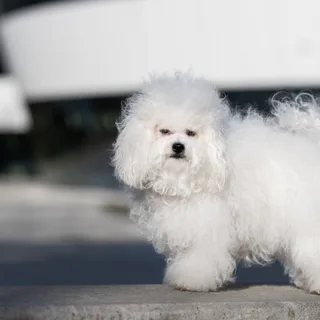
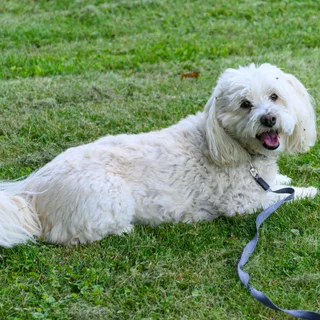
The Maltese Bichon is a small elegant dog with a proud head carriage. Its body, narrow and elongated, rests on muscular limbs with a robust bone structure. The head is fairly broad, with a flat skull, small very dark round eyes and drooping triangular ears, set high and abundantly covered with hair. Its white coat, sometimes pale ivory, is made up of very long, dense, shiny, straight and silky hair, which can exceed the height at the withers. The tail is short and drooping.
Temperament
Temperament and personality
Playful, gentle and very affectionate, the Maltese Bichon forms a close bond with its owner. Intelligent, lively and not very independent, it readily seeks cuddles and the closeness of its family. It copes poorly with prolonged absences and may be sensitive after a long period of solitude. Not very inclined to guarding, it generally appreciates other dogs and other animals. It is well suited to respectful children, but its small size means that rough handling should be avoided.
Living together
Living with children and animals
Pleasant to live with in the city as well as in the countryside, the Maltese Bichon adapts particularly well to apartment living, provided it enjoys regular outings, games and daily interactions. It likes walks and can take part in various activities suited to its size. Its family must be available, as it seeks human presence a lot and tolerates solitude with difficulty. Its coat also requires a daily care routine.
Training
Training and socialization
Training must start early, with clear, consistent and caring rules, in order to avoid capricious behavior or excessive dependence. Very intelligent, the Bichon Maltese learns easily, even if its obedience can be uneven. In particular, it must be taught gradually to stay alone for short periods. Positive reinforcement, short sessions and suitable rewards give good results.
Budget
Maltese price & budget
The purchase price varies according to the quality of the breeding, the pedigree, conformity to the standard, the lineage, the age and the intended purpose of the dog. You must add to the initial budget the health, food and grooming expenses linked to its long coat.
View cost breakdownHealth
Health at a glance
Despite its small size, the Maltese Bichon is generally robust and rarely falls ill. Particular attention must nevertheless be paid to its eyes, its teeth, its gums, its kneecaps and its trachea. Regular preventive care, good oral hygiene and veterinary follow-up help to preserve its quality of life over the long term.
Prevention & watch pointsDiet
Feed it well
The Maltese Bichon needs a complete, digestible diet adapted to small-sized dogs. The ration must take into account its age, its weight and its activity in order to support its vitality while preventing overweight.
Our feeding adviceDid you know?
Anecdotes and popularity
In Antiquity, Aristotle already mentioned a small dog named "canes melitenses". The Bichon Maltese also appears in paintings by Rubens and Goya. More recently, Bernadette Chirac received a Bichon Maltese named Sumo from her grandson Martin. Jacques Chirac then received from Michel Drucker a female dog of the same breed, named Sumette.