Origins
Where does it come from?
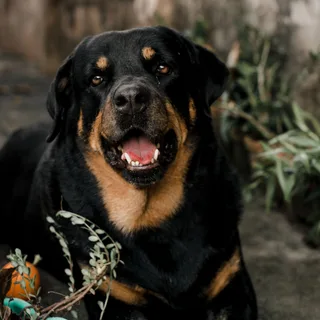
Originally from Germany, the breed owes its name to its first breeder, Frédéric Louis Dobermann (1834-1894). A tax collector, manager of a knacker's yard and tasked with collecting stray dogs for his municipality, he was looking for a courageous and biting protection dog. The breed benefited from contributions from various butcher's dogs and shepherd dogs, notably the one from Thuringia, and shares ancestors with the Rottweiler. The Dobermann then established itself as a guard dog, defense dog, livestock protection dog, police dog and companion dog. Listed under number 143 in the FCI standard, it was definitively recognized in 1955.
Appearance
What does it look like?
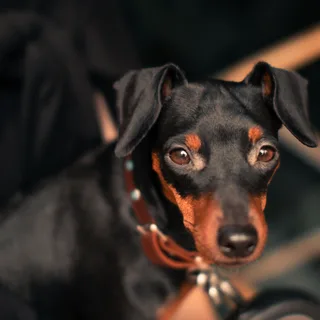
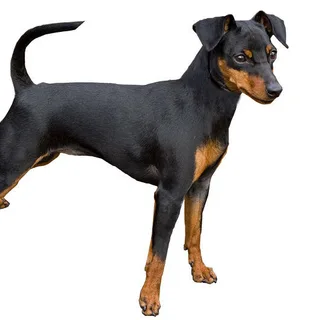
The Dobermann is a large powerful and athletic dog with an elongated head, a strong and well-proportioned skull, with medium-sized oval eyes generally dark. Its withers are clearly prominent, its back short and muscular, its loin long and muscular, its chest well developed and its belly tucked up. Its ears are set high and naturally drooping when they are not cropped, this practice being prohibited in France outside a curative reason. Its tail is set high and kept natural in countries where docking is prohibited. Its coat short, tight, harsh and lying flat has no undercoat. The coat is black or brown with clearly defined tan markings.
Temperament
Temperament and personality
Affectionate and very loyal, the Dobermann is not needlessly aggressive despite his deterrent appearance. Very attached to his owner, his family and children, he seeks to please them and to defend them with determination. Attentive, courageous and wary of strangers, he has a very pronounced guarding instinct. His assertive temperament can however make him dominant towards certain fellow dogs, especially those of the same sex.
Living together
Living with children and animals
Fundamentally calm at home when he is well-balanced, the Dobermann needs to express his power and energy on a daily basis. He enjoys long walks, games and activities that stimulate his body, his intelligence and his senses. Sensitive to cold and humidity, he must live indoors, but cramped housing suits him poorly. A house with a large fenced garden and an active owner capable of organizing frequent activities better meets his needs.
Training
Training and socialization
The Dobermann must be socialized early and receive a firm, fair and consistent education. Play and rewards encourage a balanced, respectful and happy dog. Its intelligence, responsiveness and taste for work make learning easier, but its assertive temperament requires an owner capable of setting a clear framework without brutality.
Budget
Dobermann price & budget
The purchase price depends in particular on the breeder and the dog's profile. To this initial cost is added an annual maintenance budget estimated by the source between 1 600 and 1 650 euros.
View cost breakdownHealth
Health at a glance
The Dobermann is generally robust and resilient, but it has predispositions that justify regular veterinary monitoring, particularly in terms of cardiac, joint, ocular and thyroid health. It is also sensitive to cold, humidity and extreme temperatures.
Prevention & watch pointsDiet
Feed it well
A high-quality industrial diet can cover the Dobermann's needs and support its energy level. The ration must be adapted to its size, its age and its activity, then divided into two daily meals.
Our feeding adviceDid you know?
Anecdotes and popularity
The Dobermann is sometimes nicknamed the "gendarme dog" because of its historical abilities in guarding, defense and police work. In the animated film Up, Alpha is a Dobermann belonging to Charles Muntz. The film The Dobermann Gang, released in 1972, features six Dobermanns named after famous thieves and trained to take part in the robbery of a bank. A litter generally includes 3 to 13 puppies according to the data from the source.