Origins
Where does it come from?
The German Shepherd is a German breed established from 1899 by Max Frédéric Émile von Stephanitz, who methodically selected herding dogs from central and southern Germany to obtain a working dog, hardy and well-balanced. Conceived first for driving and guarding flocks, it then established itself in many fields of work thanks to its intelligence, docility and versatility. Recognized by the FCI under number 166 and attached to group 1, it obtained its international recognition in 1955 and remains today one of the major service breeds best known in the world.
Appearance
What does it look like?
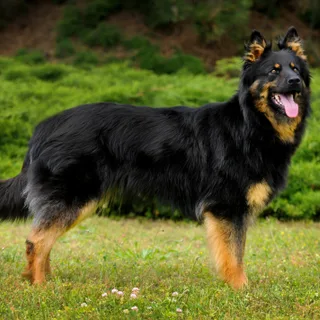
The German Shepherd is a large athletic dog, slightly elongated, solidly built without heaviness, with dry musculature and a muscular back slightly sloping. Its head is long and well proportioned, its muzzle is powerful, its ears are erect, its almond-shaped eyes are preferably dark, and its tail reaches at least the hock. The breed exists in short-haired and long-haired varieties, always with a fine and dense undercoat; the short coat is straight, harsh and lying close, while the long coat is more supple and often carries fringes. The accepted coats range mainly from black and tan to black and grey, with reddish brown, brown, yellow to light grey shades; small white spots on the chest may be tolerated but remain little desired, and the white coat is not accepted in the German Shepherd.
Temperament
Temperament and personality
The German Shepherd is a very intelligent dog, loyal, affectionate with its own and naturally vigilant. It often shows itself patient and protective with the children of its family, while keeping a clear reserve towards strangers without unwelcome aggressiveness when it is well selected and properly socialized. Courageous, sensitive, docile and willing, it appreciates having a mission, a clear framework and a strong relationship with its human.
Living together
Living with children and animals
On a daily basis, the German Shepherd needs real physical and mental exertion, with about 1 to 2 hours of activity per day depending on age, lineage and level of training. The garden alone is not enough: it needs active outings, structured exercises, scent work, guided games or dog sports to remain stable. It tolerates prolonged solitude and boredom poorly, which can lead to vocalizations, destruction, hypervigilance or controlling behaviors.
Training
Training and socialization
His training must start early, with calm, firmness, consistency and a lot of regularity. The German Shepherd learns quickly and likes to work, but his sensitivity, his power and his vigilance require serious socialization and a coherent framework from the youngest age. He often goes through a long adolescence, with a psychological maturity that may only be fully reached around 3 years, hence the importance of remaining patient, fair and consistent. Recall, self-control, leash walking and managing encounters must be worked on without brutality.
Budget
German Shepherd Dog price & budget
The price of a German Shepherd varies mainly according to the quality of health selection, the type of bloodline, the reputation of the breeding kennel and the dog's intended purpose, companionship or show. Puppies from tested parents, well socialized and raised in a serious setting often cost more, but in principle offer better guarantees regarding health and balance. Adoption from a shelter remains more economical, while requiring a good assessment of the dog's profile.
View cost breakdownHealth
Health at a glance
The German Shepherd is an overall robust and hardy breed, but its health depends greatly on the quality of selection and on moderation of its growth. Like many large dogs, it has joint, digestive, neurological and ocular predispositions that deserve careful monitoring. A highly digestible diet, a stable weight, progressive exercise and transparent breeding regarding screenings clearly improve the breed’s prognosis.
Prevention & watch pointsDiet
Feed it well
The German Shepherd needs a complete, digestible diet rich in good-quality proteins to support its musculature, recovery and often high activity. The breed may have digestive sensitivity, which makes the choice of food particularly important. The ration must always be adapted to age, size, sterilization, activity and body condition.
Our feeding adviceDid you know?
Anecdotes and popularity
The breed’s original name is Deutscher Schäferhund, and it has also been called Alsatian Shepherd, Alsatian Shepherd Dog or Alsatian Wolfdog depending on the countries and the periods. The German Shepherd has made history among service dogs in the police, the army, tracking, rescue, medical service and the assistance of visually impaired people. Its versatility explains that there are today bloodlines more work-oriented and others more companion- or show-oriented, which can strongly influence temperament and energy level.