Origins
Where does it come from?
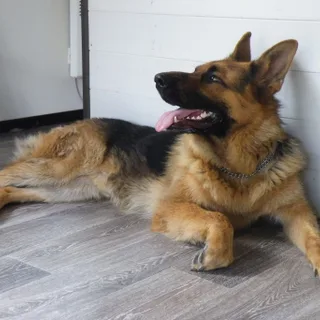
The Saarloos Wolfdog was developed in the Netherlands by Leendert Saarloos, a Dutch breeder who in the 1930s crossed a European she-wolf of Siberian lineage with a German Shepherd. His initial objective was to obtain a dog closer to nature, but selection mainly highlighted the animal’s primitive traits and sensitivity. The breed was officially recognized in 1975, then definitively by the FCI in 1981. It remains rare outside its country of origin.
Appearance
What does it look like?
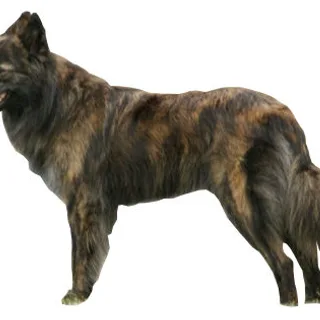
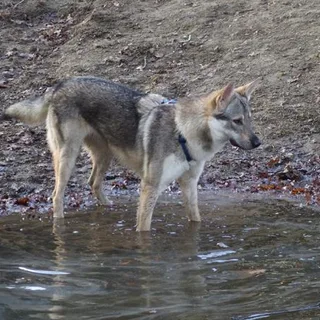
The Saarloos Wolfdog is a large wolf-like dog, athletic and harmonious, with a slender silhouette, rather long limbs and a solid bone structure without heaviness. Its head clearly recalls that of the wolf, with a flat skull, almond-shaped eyes often yellow, very expressive triangular ears and a well-furnished tail carried low at rest. Its coat, more abundant in winter thanks to a developed undercoat, is most often found in wolf-grey, forest-brown or light sand tones.
Temperament
Temperament and personality
Lively, intelligent and very independent, the Saarloos Wolfdog shows itself to be deeply attached to its social group while remaining reserved with strangers. It retains marked primitive instincts, notably a strong wariness of novelty and a tendency to avoid rather than confront. This is not a submissive dog nor one that is constantly demonstrative, but a sensitive companion that calls for a relationship based on trust.
Living together
Living with children and animals
On a daily basis, the Saarloos Wolfdog needs space, freedom of movement and a stable environment. It copes poorly with dense urban life and apartment living, and thrives more in a house with a large, well-fenced plot of land. Very observant, it can be discreet, cautious and sometimes distant, but it remains active and needs long regular outings to channel its energy.
Training
Training and socialization
Its training requires experience, consistency and very early socialization. Harsh or coercive methods are counter-productive with this sensitive and independent breed, which learns better in a clear, calm and consistent framework. The goal is not to obtain mechanical obedience, but a well-balanced dog, capable of trusting its human reference and calmly managing its environment.
Budget
Saarloos Wolfdog price & budget
The purchase price varies depending on the lineage, the reputation of the breeding kennel, compliance with the standard and the rarity of the breed. Given its demanding profile, it is essential to prioritize a reputable breeder who works on socialization, temperament and health monitoring.
View cost breakdownHealth
Health at a glance
The Saarloos Wolfdog is generally robust and hardy, with a powerful build and good overall resistance. Like many primitive-type breeds, it can however prove sensitive to certain management practices, stress and certain drug treatments. Careful and individualized veterinary monitoring remains recommended.
Prevention & watch pointsDiet
Feed it well
The diet of the Saarloos Wolfdog must support a large active dog without promoting overweight. Protein quality, digestibility and adapting the ration to age, exercise level and body condition take precedence over the mere quantity served.
Our feeding adviceDid you know?
Anecdotes and popularity
Despite its wolf-like appearance and its origin stemming from an old cross with a she-wolf, the Saarloos Wolfdog is indeed a recognized dog breed. Its very pronounced resemblance to the wolf explains part of its fascination with the public, but also many misconceptions about its behavior, because it is above all a sensitive and very particular dog, far from the profile of an easy family dog.