Origins
Where does it come from?
The Canaan Dog descends from pariah dogs of the Near East long adapted to the harsh conditions of the region. It was selected for guarding herds and homes, then established as a breed in the 20th century, notably thanks to the work of Rudolphina Menzel from the late 1940s. The breed was then spread outside Israel and definitively recognized by the FCI in 1966.
Appearance
What does it look like?
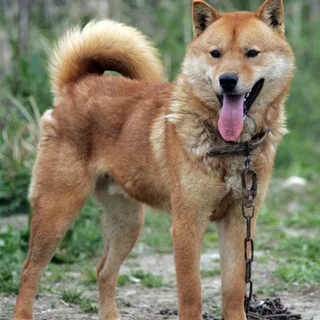
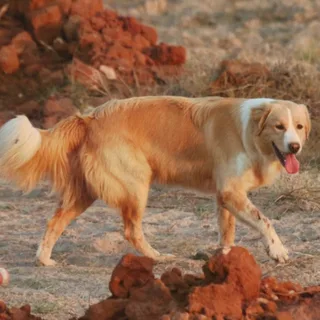
The Canaan Dog is a medium-sized dog, robust, well proportioned and able to fit into a square. Its head of medium length suggests a moderate wedge, with rather short and broad erect ears, dark brown almond-shaped eyes and a lively expression. The body is solid without heaviness, the tail is carried curled over the back, and the coat is straight, close, of fairly harsh texture, with a dense undercoat. Accepted coats range from sand to red-brown, as well as white, black or parti-coloured, with or without a symmetrical mask.
Temperament
Temperament and personality
The Canaan Dog is lively, attentive and naturally wary of strangers, which makes it a good guard dog without excessive aggressiveness. It is very attached to its owner and protective towards its social group. Its temperament combines docility, vigilance and a certain reserve, with a primitive background that makes it clear-sighted and not very demonstrative with strangers.
Living together
Living with children and animals
On a daily basis, the Canaan Dog needs activity, attention and a stable framework. He enjoys long walks, observing his environment and tasks that engage his vigilance. He can adapt to urban life if his exercise needs are truly met, but he generally prefers a house with a well-fenced garden. His attachment to his family is often accompanied by a great sensitivity to the quality of the bond and to the consistency of the living environment.
Training
Training and socialization
The education of the Canaan Dog must be firm, calm and consistent, without unnecessary harshness. It is a dog that learns well when it understands the meaning of the requests and when it keeps confidence in its handler. Positive methods, regularity and early socialization are important to channel its natural reserve towards strangers and to develop reliable obedience in varied contexts.
Budget
Canaan Dog price & budget
The Canaan Dog is a rare breed, which directly influences its price and availability. The cost mainly depends on the seriousness of the breeding, the quality of socialization, the traceability of the lineage, and the local rarity of the breed. Beyond the purchase, you should plan a regular budget for food, veterinary prevention, and everyday accessories.
View cost breakdownHealth
Health at a glance
The Canaan Dog is generally hardy and able to cope well with difficult climatic conditions thanks to its balanced build and its dense double coat. Natural selection has contributed to the overall soundness of the breed. The main point of vigilance classically cited concerns hip dysplasia, even if the breed is not reputed to be heavily burdened with known hereditary diseases.
Prevention & watch pointsDiet
Feed it well
The Canaan Dog needs a complete, digestible diet adapted to its medium size, its age and its activity. Its ration must support good muscle mass without promoting overweight. A simple, regular and well-measured diet generally suits this hardy dog very well.
Our feeding adviceDid you know?
Anecdotes and popularity
The Canaan Dog is one of the rare modern breeds directly descended from semi-wild pariah dogs of the Near East. This origin partly explains its hardiness, its vigilance and its adaptability. Although ancient in its roots, the breed remains little known in Europe, which contributes to its image as a rare and distinctive dog.