Origins
Where does it come from?
Of British origin, the Bullmastiff comes from the cross between the Mastiff and the English Bulldog. Powerful, alert and intelligent, it has traditionally been used as a guard dog and helped gamekeepers track intruders and poachers. It was trained to pin them to the ground to immobilize them rather than to bite them. The breed bears the number 157 of the FCI, belongs to group 2 and has been recognized since 1955.
Appearance
What does it look like?
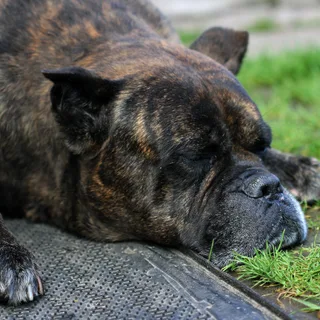
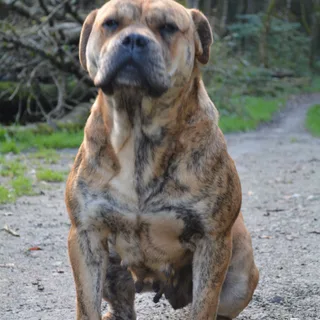
The Bullmastiff has a strong, powerful and harmonious build, without an impression of heaviness despite its compact size. Its massive, broad and high head has a pronounced stop and a black mask on the muzzle. Its medium eyes, dark or hazel, are well separated. Its V-shaped ears, darker than the body, are set high. Its solid body combines a broad and deep chest, a short and straight back, a broad and muscular loin and a well let-down flank. Its tail, set high, is thick at the base then tapers to a point. The short, harsh and close-lying coat protects against bad weather. The coat can be brindle, fawn or red, sometimes with a slight white mark on the chest.
Temperament
Temperament and personality
Beneath its placid appearance, the Bullmastiff is jovial and active. Courageous, vigilant and endowed with a deterrent stature, it is an excellent guard dog. Its calm and wisdom suit family life. It is gentle with children, reliable and protective. Its sociability with other animals is more reserved and requires early socialization.
Living together
Living with children and animals
The Bullmastiff feels in its element within its family and enjoys indoor life, while ideally benefiting from an outdoor space to move around and observe its surroundings. Active without being tireless, it is generally satisfied with daily walks and regular play sessions. It is advisable not to overexert it in order to preserve its joints.
Training
Training and socialization
Due to its physical power, the Bullmastiff must receive from a very young age a strict, fair and consistent education. Limits must be set early so that it does not gain the upper hand through its strength in adulthood. Early socialization is also necessary. It is better suited to an experienced owner or one perfectly informed about the education of such a powerful dog.
Budget
Bullmastiff price & budget
The purchase price varies notably depending on the breeder, the lineage and the puppy’s characteristics. You must also anticipate a significant annual maintenance budget, consistent with the breed’s large size.
View cost breakdownHealth
Health at a glance
The Bullmastiff has rather robust health, but its large size requires particular vigilance regarding its joints, its weight, its eyes and its digestive system. A monitored diet and regular care help to limit these risks.
Prevention & watch pointsDiet
Feed it well
The Bullmastiff's diet must be of high quality, suited to its large size and carefully measured to limit excess weight.
Our feeding adviceDid you know?
Anecdotes and popularity
The Bullmastiff was not supposed to bite the poachers it pursued with the gamekeepers, but to pin them to the ground to immobilize them. The litters observed generally number from 4 to 13 puppies.