Origins
Where does it come from?
Developed from the 1930s, the Wirehaired Hungarian Pointer comes from the cross between the Hungarian Shorthaired Pointer and the German Wirehaired Pointer. Dog of the Hungarian nobility, it was definitively recognized by the Fédération Cynologique Internationale on 27 March 1963 under number 239, in group 7 of pointing dogs. Its official current FCI standard was published on 6 April 2000.
Appearance
What does it look like?
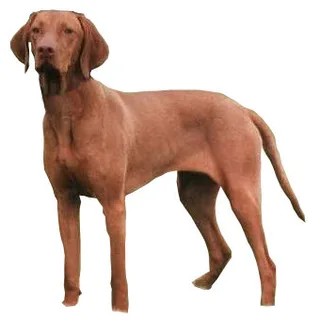
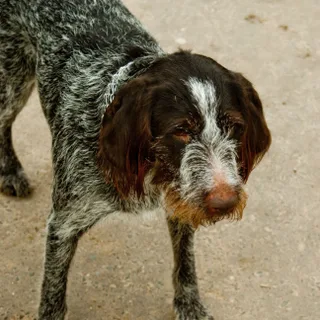
Of medium size, lean and without heaviness, it has a more robust build than the Hungarian Short-haired Pointer. Its body is slightly longer than tall, with a muscular neck, a pronounced withers, a firm and straight back, a short loin, a broad croup and a well let-down chest. Its head with a moderately broad and slightly domed skull has a truncated muzzle, strong jaws with a scissor bite and a broad nose. The ears, set moderately high, are carried slightly back and end in a rounded V. The dark brown oval eyes express liveliness and intelligence. The tail, thick at the base, is carried straight or in a slight sabre. The wire coat measures 2 to 3 cm, remains close, thick and lying flat, with a dense and harsh undercoat, bushy eyebrows and a marked beard. The coat is uniformly golden wheaten, sometimes darker on the ears.
Temperament
Temperament and personality
Intelligent, affectionate, receptive and very attached to its owner, this pointing dog is sensitive and eager to cooperate. When hunting, it works with passion and determination; its excellent nose, its reliable point and its versatility are particularly appreciated. It is generally welcoming with strangers, good with children and can live with other animals if its socialization is carefully done.
Living together
Living with children and animals
Very energetic and playful, he needs daily physical activity, space and regular contact with his owner. One to two long outings per day are necessary. His hunting instinct requires particular attention during walks and his strong tendency to vocalize must be taken into account on a daily basis.
Training
Training and socialization
Receptive and attached to its owner, it is reputed to be easy to train when learning is consistent. Measured firmness is enough: this particularly sensitive dog tolerates neither brutality nor a power struggle. Recall, leash walking, socialization and channeling the hunting instinct must be worked on early with positive methods.
Budget
Wirehaired Vizsla price & budget
The purchase price varies depending on the breeder, the lineage, the health examinations of the breeding dogs and the dog's destination. The reference sheet places the usual acquisition budget between 400 and 800 euros.
View cost breakdownHealth
Health at a glance
Robust and endowed with generally sound health, it benefits from a protective double coat. Regular veterinary monitoring remains important due to several known predispositions.
Prevention & watch pointsDiet
Feed it well
This athletic dog needs a complete and balanced diet, adapted to its age, weight, body condition and activity level. The ration must support effort without promoting excessive weight gain.
Our feeding adviceDid you know?
Anecdotes and popularity
Its Hungarian name is Drötzörü Magyar Vizsla. The breed was created to combine the hunting qualities of the Vizsla and the protection of a wire coat suited to bad weather and injuries.