Origins
Where does it come from?
The American Bulldog descends from the Old English Working Bulldog, formerly used in Great Britain to drive cattle and guard farms. English migrants brought these working dogs to the United States, where a selection carried out mainly in the states of the Southeast, notably in Georgia, Alabama and Florida, favored powerful and athletic individuals. John D. Johnson developed the Bully type, more massive, while Allan Scott shaped the Standard type, more slender. The first individuals were registered by the National Kennel Club in 1970 under the name American Pit Bulldog, then renamed American Bulldog in order to avoid any confusion with the Pitbull. The breed is not recognized by the Fédération Cynologique Internationale. In France, the French Club of the American Bulldog was created in 1999.
Appearance
What does it look like?
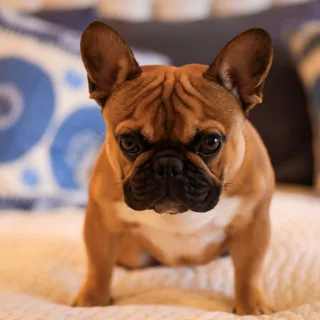
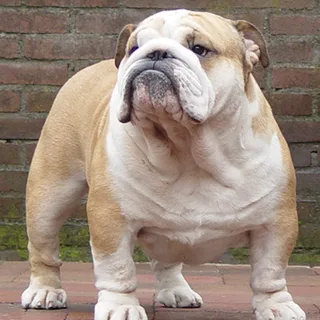
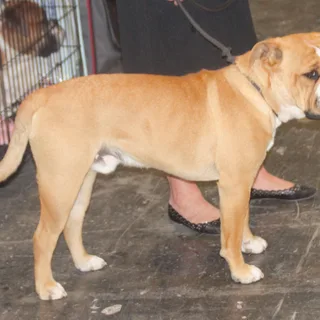
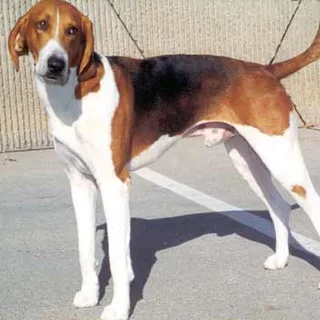
The American Bulldog is a powerful, compact and athletic molosser, endowed with a solid bone structure and well-developed musculature. The Bully type is stockier, with a short muzzle and a pronounced stop, while the Standard type is longer-legged, more slender and has a longer muzzle; many dogs today combine both types. The head is large, broad and square, the eyes are small and dark, and the medium-sized ears are set rather low and folded to the sides. The body remains massive but harmonious, with a strong neck, a broad chest, a straight back and a sloping croup. The coat is harsh, very short and almost close-cropped. The coat color is white with or without colored markings, or colored with white markings. The tail, strong at the base, tapers toward its tip.
Temperament
Temperament and personality
Loyal, devoted and affectionate with his own, the American Bulldog is a cheerful, playful and expressive family companion. His courage, vigilance and reserve towards strangers make him an excellent guard dog without being naturally aggressive. He may however seek to dominate his congeners, especially dogs of the same sex, which requires early and ongoing socialization.
Living together
Living with children and animals
Active working dog, the American Bulldog needs long walks, regular exercise and activities shared with its owner. It enjoys life at home but does not tolerate prolonged inactivity well. Its power requires responsible handling, and its interactions with other animals must be prepared with care. Its short coat is simply brushed once a week and its shedding remains moderate.
Training
Training and socialization
Training must begin as soon as the puppy arrives and combine firmness, consistency, fairness and positive reinforcement. The rules must be stable, because this powerful dog can test limits. Early socialization with people, varied environments and well-balanced dogs is essential, especially to prevent tensions between dogs of the same sex. Recall, leash walking and managing excitement should be worked on regularly.
Budget
American Bulldog price & budget
The purchase price varies depending on the lineage, the quality of the selection work, the health screenings carried out, the reputation of the breeding kennel and the dog's intended purpose. The initial cost represents only part of the budget to plan for this large dog.
View cost breakdownHealth
Health at a glance
Overall robust and resilient, the American Bulldog nevertheless shows predispositions to certain joint disorders and to hernias. Its growth, weight and physical activity must be supervised in order to preserve its musculoskeletal system.
Prevention & watch pointsDiet
Feed it well
This muscular and active dog needs a complete, digestible and properly portioned diet, adapted to its age, its level of exercise and its size. During growth, a large-breed puppy formula helps control the rate of development.
Our feeding adviceDid you know?
Anecdotes and popularity
The breed is also called American Bulldog. It has two major historical types: the Bully developed by John D. Johnson and the Standard associated with Allan Scott. Many modern dogs come from lines combining these two morphologies. Before adopting its current name, it was registered in the United States under the name American Pit Bulldog.