Origins
Where does it come from?
The Norrbotten Spitz is an ancient Nordic breed whose ancestors are thought to have been close to Laika-type dogs once present in the Arctic regions of Scandinavia. Shaped by natural selection in a harsh environment, it long accompanied local hunters for small fur-bearing game. After the Second World War, the decline in the value of furs greatly reduced interest in the breed, to the point of bringing it close to extinction. Its preservation owes much to the work carried out in Sweden, notably in northern Bothnia, from the end of the 1960s.
Appearance
What does it look like?
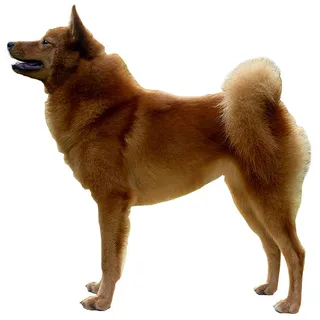
The Norrbotten Spitz is a small Spitz-type dog, fitting into a rectangle, well proportioned, muscular and agile. Its triangular head is strong and clean, with erect high-set ears and dark brown almond-shaped eyes with a lively expression. Its back is short and solid, its chest moderate, its tail is carried high and curved. Its coat is double, with a fine and dense undercoat and a short, straight topcoat and a little more abundant on the neck, the back of the thighs and under the tail. The desired color is white with large well-defined red to yellow markings.
Temperament
Temperament and personality
The Norrbotten Spitz is an alert, courageous and self-assured dog. A hunter at heart, it retains great liveliness and a pronounced instinct, while remaining of a gentle and pleasant temperament on a daily basis. It tends to be rather vocal, vigilant and reserved towards strangers, without lacking attachment to its home.
Living together
Living with children and animals
This active dog needs daily exercise and regular activities to stay balanced. It can adapt to varied lifestyles if its physical needs are met, but it prefers an environment with access to a secure outdoor space. Its hunting instinct and liveliness require supervision on walks and a sufficiently stimulating life.
Training
Training and socialization
The training of the Norrbotten Spitz must start early, especially recall, because its hunting instinct can quickly take over. It responds better to consistent handling, firm without harshness, with positive reinforcement methods and regular exercises. Consistency is important to channel its energy and achieve good cooperation.
Budget
Norrbottenspets price & budget
The purchase price of the Norrbotten Spitz remains mainly linked to the rarity of the breed, the quality of the origins and the seriousness of the breeding. As it is an uncommon dog, the supply may be more limited than for more widespread breeds.
View cost breakdownHealth
Health at a glance
The Norrbotten Spitz is generally a robust and hardy dog, well suited to harsh climates thanks to its double coat. No specific disease is systematically associated with the breed, but vigilance remains useful regarding certain orthopedic and neurological conditions identified in a few individuals.
Prevention & watch pointsDiet
Feed it well
The Norrbotten Spitz needs a balanced, high-quality diet, adjusted to its age, activity level and body condition. As it is a small active dog, the goal is to meet its energy needs without promoting excess weight.
Our feeding adviceDid you know?
Anecdotes and popularity
The Norrbotten Spitz was notably used for hunting capercaillie and various small fur-bearing animals in northern Europe. Its history is also marked by a near-disappearance in the middle of the 20th century, followed by conservation work that enabled the recognition and revival of the breed in Sweden.