Origins
Where does it come from?
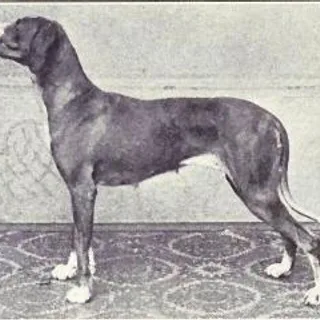
Known for hundreds of years in the Iberian Peninsula, the Portuguese Pointer descends from the ancient Peninsular Braque. Its presence is attested at least since the 12th century and its breeding is ancient in Portugal, where it was formerly called "Podengo de Mostra". It distinguished itself as a falconry dog in the royal kennels and those of the nobility. The Fédération Cynologique Internationale classifies it among the continental pointing dogs, under standard no. 187, with recognition dating from 1955.
Appearance
What does it look like?
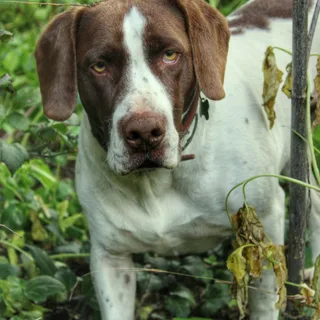
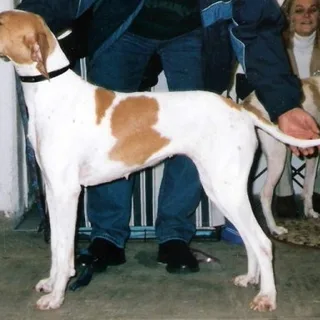
Of medium size and of braccoid type, the Portuguese Pointer has a powerful, rustic and harmonious constitution, with an elegant silhouette inscribed in a square. Its body is robust, the back short, broad and straight, the loin very muscular and the chest high, broad and ample. Its well-proportioned head has a square skull, a pronounced stop, a black nose and jaws articulated in a scissor bite. Its brown eyes, oval to almost round, express a lot of liveliness. The triangular, flat and drooping ears are set above the line of the eyes. The tail, of medium length, is straight and tapers towards its tip. The coat is short, dense, close and hard to the touch, without undercoat. The coat colour is yellow in different shades, with possible white markings on the head, neck, forechest, limbs and the tip of the tail.
Temperament
Temperament and personality
Gentle, calm and very affectionate, the Portuguese Pointer forms a close bond with its owner. It can be distant with its fellow dogs while remaining sociable. When hunting, it stands out for its curiosity, enthusiasm, stamina and versatility. It works on varied terrain and adapts to different climates and game.
Living together
Living with children and animals
Calm most of the time, this hunting dog nevertheless needs a lot of activity and stimulation. Two long daily walks are recommended. It thrives as close to nature as possible, ideally in a large fenced area in the countryside. Apartment living suits it poorly. Its socialization must be carried out with care, especially with other dogs and animals.
Training
Training and socialization
Like many hunting dogs, the Portuguese Pointer is not naturally very docile, without however being particularly complicated to train. Its handling must be firm, consistent and free of brutality. A gradual, regular and motivating training helps to channel its energy and its hunting instinct.
Budget
Portuguese Pointer price & budget
The purchase price varies depending on the kennel, the bloodline, the pedigree, the age and the dog's intended purpose. It is also important to assess the quality of socialization, health monitoring and breeding conditions.
View cost breakdownHealth
Health at a glance
The Portuguese Pointer is generally robust and can withstand various climatic conditions despite its short, simple coat. Regular veterinary monitoring remains necessary due to known joint and dermatological predispositions.
Prevention & watch pointsDiet
Feed it well
The Portuguese Pointer needs a quality diet, adapted to its age, its size and its level of physical activity. The needs of an active hunting dog differ significantly from those of a less active subject.
Our feeding adviceDid you know?
Anecdotes and popularity
The breed is also known under the names Portuguese Pointer, Perdigueiro Português, Portuguese Pointer and Portuguese Pointing Dog. Formerly called "Podengo de Mostra", it was particularly appreciated for falconry in the royal kennels and those of the Portuguese nobility. A litter usually has 5 to 8 puppies.