Origins
Where does it come from?
The origins of the Grand Épagneul de Münster are ancient and linked to the hunting dogs of the Middle Ages, then to the Stöberhund, Wachtelhund and pointers of the 19th century. A member of the large family of German pointing dogs, its breeding was structured as a breed in its own right from 1922, with organized monitoring of litters by the Verband Grosse Münsterländer e.V.
Appearance
What does it look like?
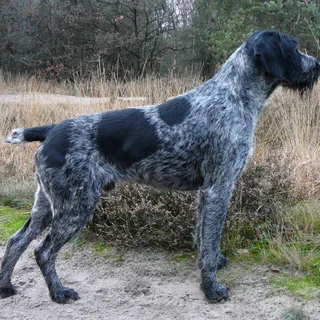
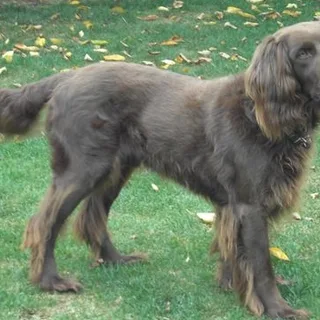
The Grand Münsterländer is a solidly built, well-proportioned and muscular dog, whose outline fits almost into a square. Its neck is strong, its back short and firm, its chest broad and deep, and its elongated head expresses nobility and intelligence. Its coat is long, dense and rather smooth, with fringes on the ears, the back of the limbs and the tail. The coat is white with black markings and speckling, blue roan or entirely black, the head always being black.
Temperament
Temperament and personality
The Large Münsterländer is a lively, reliable and pleasant dog, with a balanced temperament. Very work-oriented, it stays close to its owner and enjoys pleasing him. Affectionate without being intrusive, it is not known to be nervous and retains good stability of character.
Living together
Living with children and animals
This pointing dog needs real daily exercise and thrives in wide open spaces, on varied terrain, notably in the forest and at the water’s edge. It does not tolerate an exclusively urban life well, and even less so an apartment. With long and regular outings, it proves to be available, enduring and pleasant to live with.
Training
Training and socialization
The Grand Münsterländer requires a firm, consistent education without brutality. Its taste for work and its willingness to please make learning easier, provided that a clear framework is offered from the earliest age. Recall must be worked on early, as with many hunting dogs.
Budget
Large Münsterländer price & budget
The Grand Münsterländer remains a relatively little-known breed. The purchase price depends mainly on the seriousness of the breeding, the health tests carried out, the quality of socialization and the orientation of the lines, notably work or companion.
View cost breakdownHealth
Health at a glance
The Grand Münsterländer is overall a rather robust dog, with good general resistance. The breed is not among the most fragile, but it deserves serious monitoring like any large active dog, particularly from an orthopedic and ophthalmological standpoint.
Prevention & watch pointsDiet
Feed it well
The Grand Münsterländer needs a complete, balanced, good-quality diet, adapted to its age, its size and above all to its level of physical activity. A hunting dog or a very sporty dog will not have the same needs as an individual living mainly with a family.
Our feeding adviceDid you know?
Anecdotes and popularity
Versatile both before and after the shot, the Grand Münsterländer is appreciated for its ability to work on different terrains, including in water. Its modern selection was organized as early as 1922, which helped to establish a hunting breed recognized by the FCI under number 118.