Origins
Where does it come from?
Originally from central Brittany, the Épagneul Breton descends from ancient Oysel dogs and was developed through crossbreeding with spaniels, pointers and setters. Established at the beginning of the 20th century, the breed was officially created in 1907 and then recognized by the FCI in 1954. Above all a pointing dog, it later established itself as a family companion thanks to its balance and its closeness to humans.
Appearance
What does it look like?
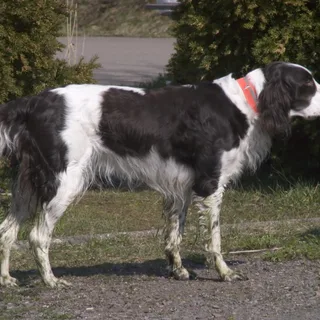
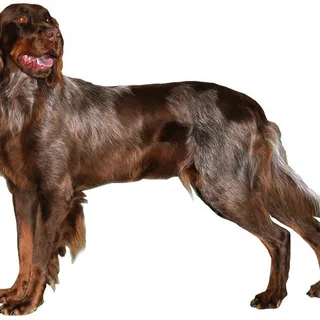
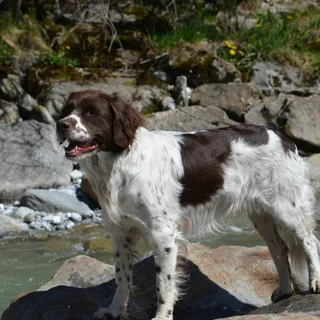
The Épagneul Breton is the smallest of the pointing dogs, with a compact silhouette, a solid bone structure and a very lively expression. It has a head with a rounded skull, oblique eyes matching the coat, ears set high and rather short, as well as a naturally short tail or absent in some individuals. Its coat is fine, flat or slightly wavy, never curly, with coats often white and orange, white and black, white and brown, sometimes tricolour or roan.
Temperament
Temperament and personality
Cheerful, sensitive and very affectionate, the Brittany Spaniel lives as close as possible to its family and seeks a strong bond with its humans. It is sociable with children, welcoming with visitors and generally compatible with other animals when it is well socialized. Its hunting instinct nevertheless remains very present, which fuels its enthusiasm, its curiosity and its need for activity.
Living together
Living with children and animals
On a daily basis, it is a lively, hardy dog and always ready to go out. It copes poorly with prolonged inactivity and repeated solitude, and it thrives clearly better in a home able to offer it long walks, games, scent activities or a hunting practice. In an apartment, it quickly lacks stimulation if it does not have enough physical and mental exercise.
Training
Training and socialization
Intelligent and strong-willed, the Brittany Spaniel is generally easy to train provided you start early and remain consistent. A gentle, positive and firm method suits him better than a harsh approach, because he is a sensitive dog. Recall, scent management and self-control are important points to work on as a priority in this hunting breed.
Budget
Brittany price & budget
The acquisition price of the Épagneul Breton depends mainly on the quality of the breeding, the pedigree, the health tests carried out on the breeding dogs and the orientation of the lines. A serious offer prioritizes traceability, socialization and health monitoring rather than an abnormally low price.
View cost breakdownHealth
Health at a glance
The Épagneul Breton is overall a hardy and resilient dog, with generally satisfactory health when it comes from a reputable breeder and benefits from regular monitoring. The main points of vigilance mainly concern the joints and the ears, more exposed in an active dog that readily spends time outdoors.
Prevention & watch pointsDiet
Feed it well
The diet of the Épagneul Breton must support its activity while avoiding excess calories. A complete, good-quality food, given regularly and adapted to its age, its size and its level of exercise, helps it maintain its physical condition and endurance.
Our feeding adviceDid you know?
Anecdotes and popularity
The Épagneul Breton is the first French pointing dog breed and also the smallest in this category. It is known for sometimes being born without a tail or with a very short tail, a natural characteristic sought after in the standard. Its name remains linked to Brittany, the historic cradle of the breed.