Origins
Where does it come from?
The Chien courant d'Istrie à poil dur descends from an ancient hunting breed originating from Istria, a peninsula of the Adriatic located in present-day Croatia. Its harsh coat allowed it to withstand the low temperatures of this largely mountainous region. The breed was described as early as 1719 in a manuscript by the bishop of Dakovo, Petar Bakic, who traced its origins back to the 14th century. The Fédération Cynologique Internationale published its first standard on 6 April 1955 and definitively recognized it on the same date. The currently valid FCI standard was published on 3 November 2014.
Appearance
What does it look like?
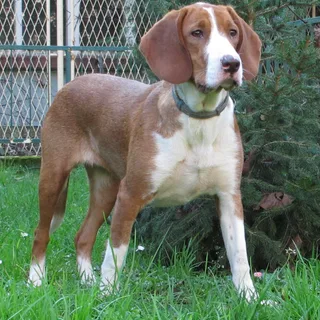
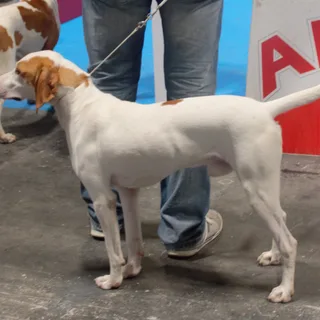
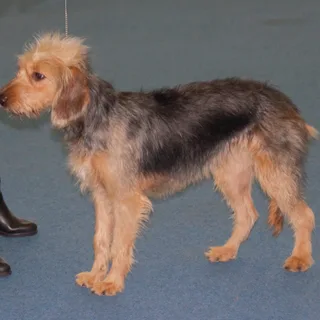
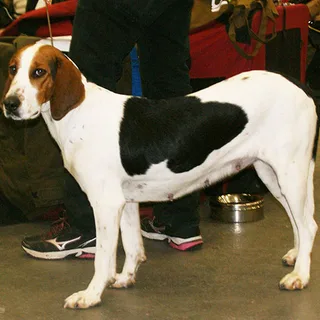
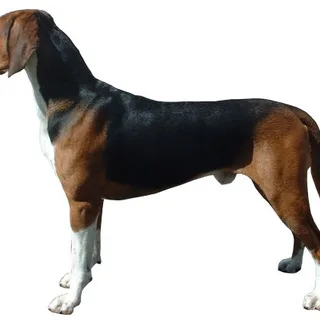
Medium-sized dog with a rustic appearance, it has a strong body, harmoniously developed, robust and endowed with a solid bone structure. Its long head is well proportioned, with a skull slightly longer than the muzzle, a moderately developed stop and strong jaws with a scissor bite. Its dark brown oval eyes give it a serious expression, while its triangular, pendant ears of medium length are set at the level of the eye line. Its neck is strong and muscular, its withers well defined, its chest deep and broad and its croup powerful. Its tail, strong at the base and well furnished with hair, is carried sabre-like. Its topcoat, 5 to 8 cm long, harsh, neither lying flat nor curly, forms a moustache, beard and thick eyebrows; it is associated with a short, dense undercoat. The coat is snow white with yellow-orange markings, notably on the ears.
Temperament
Temperament and personality
Balanced, rather gentle and attached to its owner, the Chien courant d'Istrie à poil dur retains a real independence and a very pronounced hunting instinct. Tough and hardy, it works in all weather conditions and on difficult terrain. Its protective instinct remains moderate and it may be reserved towards strangers.
Living together
Living with children and animals
This scenthound needs to exercise and be stimulated every day. A long daily walk is necessary, ideally complemented by activities that allow him to use his endurance and his sense of smell. Although he is above all a hunting dog needing space and freedom, he can adapt to the city and even to apartment living if his activity needs are truly met. His compatibility with children and other animals is average and requires careful socialization.
Training
Training and socialization
His training must begin early and be based on a balance between firmness, consistency and gentleness. He must quickly learn the limits not to be crossed. His hunting instinct and his independence make obedience less spontaneous, but he absorbs hunting instructions fairly quickly. Recall and socialization deserve particular attention.
Budget
Istrian Coarse-haired Hound price & budget
The purchase price varies depending on the breeder, the lineage and the health guarantees. Annual maintenance is generally estimated between 450 and 600 euros, excluding unforeseen health expenses.
View cost breakdownHealth
Health at a glance
With a robust and rustic build, the Wire-haired Istrian Hound generally enjoys solid health when it receives appropriate care. The breed is not hypoallergenic. Orthopedic and ear monitoring is nevertheless recommended.
Prevention & watch pointsDiet
Feed it well
Its diet must be of good quality and provide all the necessary nutrients. It must be adapted to its age, its size and above all to its level of exercise.
Our feeding adviceDid you know?
Anecdotes and popularity
The breed is also known under the names Istarski Ostrodlaki Gonic and Istrian Coarse Haired Hound. It is less popular than the Chien courant d'Istrie à poil ras, with which it must not be confused. It is recognized by the FCI as well as by the AKC, the ANKC, the CKC, the KC, the NZKC and the UKC. A litter generally has 4 to 8 puppies.