Origins
Where does it come from?
The Berger de Savoie is a breed with very ancient origins, long used for driving and guarding herds of cows in a mountainous environment. Its name is said to have been given by the Swiss architect Marcelle Bruder, who adopted a representative of this canine population in 1947 during a stay in Savoie and later understood that it was not a simple crossbred dog. The name Berger des Alpes appeared later. Its characteristics result mainly from natural selection, human intervention having been limited. The breed is not recognized by the Fédération Cynologique Internationale. The Société du Berger de Savoie, created in 2002, works for its preservation.
Appearance
What does it look like?
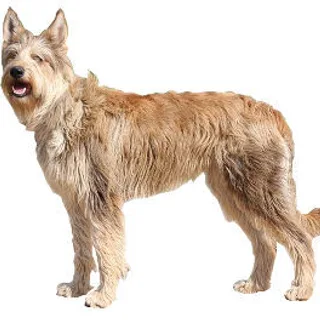
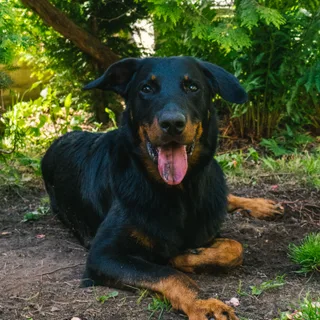
The Berger de Savoie is a medium-lined dog of medium size, muscular and with a solid bone structure without appearing heavy. Its body, longer than it is tall at the withers, fits into a rectangle. Its medium-sized head is well proportioned. Its triangular ears, medium and folded, fall to the sides and rise slightly at their base when it is attentive. Its fairly large eyes can be hazel or blue, sometimes wall-eyed in harlequin subjects. Its topcoat, short or medium-long, harsh, thick, dense and lying flat, is associated with an undercoat. The coat is black and tan or harlequin and tan, with white markings of variable intensity. The tail, set at medium height, is carried in a sickle when the dog is attentive.
Temperament
Temperament and personality
Resistant, hardy and vigilant, the Berger de Savoie brings together the qualities expected of a mountain and herding dog. Very close to its owner and its family, it is affectionate, playful, intelligent and docile. Attentive to suspicious approaches when guarding a property, it also appreciates the company of other animals. It likes to work and to make itself useful.
Living together
Living with children and animals
The Berger de Savoie needs space, freedom, activity and the presence of its owner. It tolerates inactivity and boredom poorly and thrives more near nature, ideally in a house with a large fenced garden. Long and frequent daily outings are necessary for it. It enjoys hikes, dog sports and missions such as guarding a herd or the house. Life in an apartment or in cramped housing suits it little.
Training
Training and socialization
Intelligent, obedient and motivated by work, the Berger de Savoie is relatively easy to train. Its training must be consistent and show a certain firmness in order to prevent undesirable behaviors, without any brutality because this dog is sensitive.
Budget
Berger de Savoie price & budget
The price of a Berger de Savoie varies depending on the lineage, the seriousness of the breeding, the screenings and the socialization. The maintenance budget (food, veterinary care, training) often exceeds the purchase price over time.
View cost breakdownHealth
Health at a glance
The Berger de Savoie is a rustic, robust and hardy dog, well suited to life in the mountains. Its double coat provides good protection against cold and bad weather, without making it insensitive to extreme weather conditions. No particular predisposition to a disease or an abnormality is reported by the reference sheet.
Prevention & watch pointsDiet
Feed it well
The Berger de Savoie is not known to be difficult in terms of diet. It can be given a traditional or industrial diet provided that it is balanced and suited to its age, its weight, its size and its level of activity.
Our feeding adviceDid you know?
Anecdotes and popularity
The Berger de Savoie is also called the Alpine Shepherd. The breed owes its name to Marcelle Bruder, who discovered in 1947 in Savoie a dog that she first thought was a crossbreed before identifying a well-defined canine variety. A dedicated association, the Société du Berger de Savoie, has been working since 2002 to safeguard this canine population not recognized by the FCI.