---
title: "Turkish Angora - temperament, price, health, breeders | Pedibase"
description: "Everything to know about the Turkish Angora (Turkey): temperament, size, health, lifespan of 12-18 years, feeding, price, and verified breeders."
canonical_url: "https://www.pedibase.com/en/cat-breed/turkish-angora"
meta:
"og:description": "Everything to know about the Turkish Angora (Turkey): temperament, size, health, lifespan of 12-18 years, feeding, price, and verified breeders."
"og:image": "https://www.pedibase.com/_img/rs:fill:1200:630/el:1/q:80/f:jpg/plain/s3://media-pedibase/public/5246/pexels-photo-38793375.jpeg"
"og:image:alt": "Dog and cat breeders near you"
"og:image:height": "630"
"og:image:width": "1200"
"og:title": "Turkish Angora - temperament, price, health, breeders"
"twitter:description": "Everything to know about the Turkish Angora (Turkey): temperament, size, health, lifespan of 12-18 years, feeding, price, and verified breeders."
"twitter:image": "https://www.pedibase.com/_img/rs:fill:1200:630/el:1/q:80/f:jpg/plain/s3://media-pedibase/public/5246/pexels-photo-38793375.jpeg"
"twitter:title": "Turkish Angora - temperament, price, health, breeders"
---
> Index of every page on this site: [llms.txt](https://www.pedibase.com/llms.txt)
+12
Cats
# The Turkish Angora: temperament, price, health, and breeders
Turkey
An elegant, lively cat that is very attached to its family.
Size MediumLife expectancy 12–18 yearsBudget ≈ €65/monthKitten €500 – €1,200
[Find a breeder 16](https://www.pedibase.com/en/breeders-of-turkish-angora) [ Compare with other breeds](https://www.pedibase.com/en/compare-cat-breeds?races=turkish-angora)
The right choice?
## Is this breed right for you?
[Which cat is right for you?](https://www.pedibase.com/en/choose-your-cat)
Families and children Very good
Daily exercise needs High
Apartment living Fair
First-time owners Very good
Other pets Very good
Tolerance of being alone Fair
Vocalization Talkative
Strengths and weaknesses
- Sociable: He likes the company of his family and is generally affectionate and demonstrative.
- Intelligent: His quick-wittedness makes education and learning routines easier.
- Moderate grooming: His light undercoat often makes brushing simpler than in other long-haired cats.
- Playful and agile: He enjoys activities, games and interactions that engage his body and mind.
- Does not tolerate confinement well: A life that is too confined or lacking in stimulation can harm its balance.
- Assertive temperament: It can be very present and sometimes stubborn if its environment does not suit it.
- Increased brushing during shedding: More frequent grooming is necessary during periods of hair loss.
- Watch for deafness: White individuals require particular attention in terms of hearing.
Who is it for?
Ideal for
- Families often at home: He enjoys regular interactions and closeness with his humans.
- Active households: His lively and playful temperament is well suited to a stimulating daily life.
- Homes with secure space: He benefits more from an environment offering space or controlled outdoor access.
Not recommended for
- Small apartments with little enrichment: It may get bored in an environment that is too confined and monotonous.
- People who are often absent: Its need for interaction and attention is less compatible with prolonged solitude.
- Households looking for a very placid cat: Its energy, curiosity, and personality may surprise adopters wanting a very discreet cat.
Meet the breed
## What does it look like?
1,75 mHuman
33 cmTurkish Angora
- Height at the withers
- 30–35 cm
- Weight
- 2–5 kg
- Coat
- Semi-long to long, silky
- Origin
- Turkey
- Grooming
- Moderate grooming needs
## Photos and videos
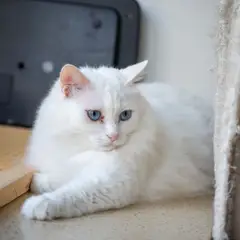
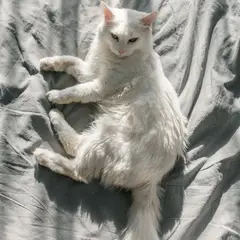
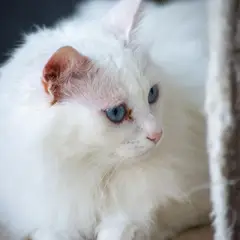
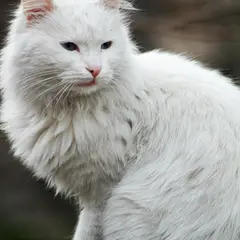
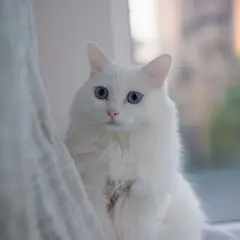
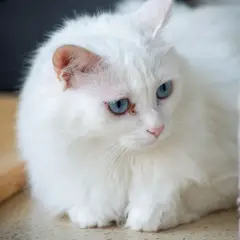
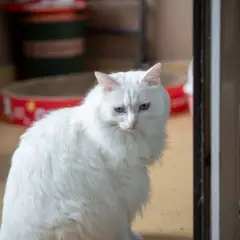
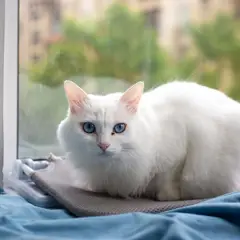
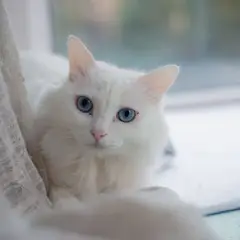
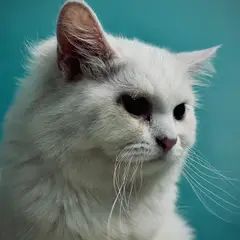
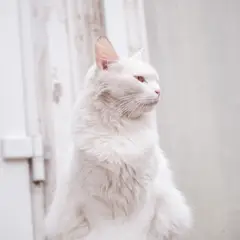
See the Turkish Angora in photos and videos: coat colors, size, and distinctive expressions.

Origins
## Where does it come from?
The Turkish Angora is an ancient breed originating from Ankara, formerly called Angora, in Turkey. Highly appreciated for its slender silhouette and silky coat, it was introduced to Europe in the 17th century and quickly aroused the interest of courts and artists. The breed then experienced a decline in the face of the success of the Persian, before being revived by European and American breeders after the Second World War. It is now recognized by the main feline organizations.
Appearance
## What does it look like?
The Turkish Angora is a slender, fine and elegant cat, but well muscled under its coat. Its head forms a triangle with softened lines, with large upright ears and slightly slanted almond-shaped eyes. Its coat is semi-long to long, light, silky and low in undercoat, with more abundant fur on the belly, chest and tail. All colors are accepted except chocolate, cinnamon, lilac and fawn, even if the white coat remains the most emblematic.
Temperament
## Temperament and personality
The Turkish Angora is a sociable, demonstrative and intelligent cat. It enjoys the company of its family, readily seeks petting and may like being the center of attention. It nevertheless retains a degree of independence and a strong-willed temperament. Playful, agile and lively, it generally gets along well with children, its fellow cats and other pets when it is well socialized.
Affectionate Playful Intelligent Easy to train Sociable
Living together
## Living with children and other pets
On a daily basis, the Turkish Angora is active, curious and agile in its movements. It likes to explore, climb and play, and does not tolerate well a life that is too confined or monotonous. It can alternate moments of calm with phases of marked activity, especially if it has space and stimulation. It is also known for its unusual attraction to water for a cat.
Training
## Training and socialization
The Turkish Angora can be trained fairly easily thanks to its quick wit and its closeness to humans. Early socialization, stable routines and positive reinforcement help to guide its assertive temperament without making it shut down. It enjoys interactive games, high perches and activities that stimulate its intelligence. An enriched environment helps it stay balanced.
Budget
## Price and budget for the Turkish Angora
The price of a Turkish Angora varies depending on rarity, type, health tests and socialization. Maintenance (food, litter, veterinarian) represents a regular budget.
[See cost breakdown](https://www.pedibase.com/en/cat-breed/turkish-angora/price)
Health
## Health at a glance
The Turkish Angora is overall a solid and robust cat. It does not show any major widely recognized predisposition to a large number of specific diseases, but regular veterinary follow-up remains essential as for any purebred cat. Vaccination, parasite prevention and monitoring of development in the kitten remain essential.
[Prevention and things to watch for](https://www.pedibase.com/en/cat-breed/turkish-angora/health)
Nutrition
## Feeding your pet well
The Turkish Angora needs a high-quality diet, rich in animal proteins, vitamins and trace elements to support its muscle mass, activity level and the beauty of its coat. A well-digested ration adapted to its age, lifestyle and physiological status should be preferred.
[Our feeding advice](https://www.pedibase.com/en/cat-breed/turkish-angora/food)
Did you know?
## Fun facts and popularity
The Turkish Angora owes its name to the city of Ankara, formerly Angora. Long admired in European courts for its refined appearance, it nearly disappeared before being preserved by dedicated breeding programs. It is also known for liking water more readily than many other cats, a trait often cited by its enthusiasts.
FAQ
## Frequently asked questions about the Turkish Angora
Answers to common questions from future owners before their new companion arrives.
### Is the Turkish Angora suited to apartment living?
It can live in an apartment if its environment is very enriching, but it appreciates space more and does not tolerate an overly confined life without stimulation or secure access to the outdoors.
### Does the Turkish Angora shed a lot?
Its shedding generally remains moderate and its grooming is often simpler than that of other long-haired cats thanks to its very light undercoat, but more frequent brushing is useful during shedding periods.
### Does the Turkish Angora get along with children and other animals?
Yes, it is often playful, sociable, and compatible with children as well as other pets, provided that introductions are done properly and everyone has their own space.
## Find a Turkish Angora breeder
The areas where Pedibase lists the most Turkish Angora breeders, along with their litters and typical prices.
[Turkish Angora breeders in Île-de-France5](https://www.pedibase.com/en/breeders-of-turkish-angora/ile-de-france)
### Turkish Angora breeders by country
[23 breeders of Turkish Angora in Germany](https://www.pedibase.com/en/breeders-of-turkish-angora/germany) [16 breeders of Turkish Angora in France](https://www.pedibase.com/en/breeders-of-turkish-angora) [3 breeders of Turkish Angora in Austria](https://www.pedibase.com/en/breeders-of-turkish-angora/austria) [1 breeder of Turkish Angora in Belgium](https://www.pedibase.com/en/breeders-of-turkish-angora/belgium) [1 breeder of Turkish Angora in Denmark](https://www.pedibase.com/en/breeders-of-turkish-angora/denmark)
[All breeders of Turkish Angora in France](https://www.pedibase.com/en/breeders-of-turkish-angora)
## Ready to welcome a Turkish Angora?
Find a registered, verified breeder near you and meet your future companion with confidence.
[View breeders](https://www.pedibase.com/en/breeders-of-turkish-angora)
## Discover other breeds
[Turkish Van
](https://www.pedibase.com/en/cat-breed/turkish-van)
[Balinese
](https://www.pedibase.com/en/cat-breed/balinese)
[British Longhair
](https://www.pedibase.com/en/cat-breed/british-longhair)
[Cymric
](https://www.pedibase.com/en/cat-breed/cymric)
[Mandarin
](https://www.pedibase.com/en/cat-breed/mandarin)
```json
{"@context":"https://schema.org","@graph":[{"@id":"https://www.pedibase.com/#website","@type":"WebSite","description":"Find dog and cat breeders near you. France's leading breeder directory, with an interactive map, breed information, and verified reviews.","inLanguage":"en","name":"Pedibase","url":"https://www.pedibase.com","potentialAction":[{"@type":"SearchAction","target":{"@type":"EntryPoint","urlTemplate":"https://www.pedibase.com/en/search?q={search_term_string}"},"query-input":"required name=search_term_string"}],"publisher":{"@id":"https://www.pedibase.com/#identity"},"translationOfWork":{"@id":"https://www.pedibase.com/#website"}},{"@id":"https://www.pedibase.com/en/cat-breed/turkish-angora#webpage","description":"Everything to know about the Turkish Angora (Turkey): temperament, size, health, lifespan of 12-18 years, feeding, price, and verified breeders.","name":"Turkish Angora - temperament, price, health, breeders","url":"https://www.pedibase.com/en/cat-breed/turkish-angora","@type":["WebPage","FAQPage"],"breadcrumb":{"@id":"https://www.pedibase.com/en/cat-breed/turkish-angora#breadcrumb"},"isPartOf":{"@id":"https://www.pedibase.com/en#website"},"mainEntity":[{"@id":"https://www.pedibase.com/en/cat-breed/turkish-angora#/schema/question/1"},{"@id":"https://www.pedibase.com/en/cat-breed/turkish-angora#/schema/question/2"},{"@id":"https://www.pedibase.com/en/cat-breed/turkish-angora#/schema/question/3"}],"potentialAction":[{"@type":"ReadAction","target":["https://www.pedibase.com/en/cat-breed/turkish-angora"]}],"primaryImageOfPage":{"@type":"ImageObject","url":"https://www.pedibase.com/_img/rs:fill:1200:630/el:1/q:80/f:jpg/plain/s3://media-pedibase/public/5246/pexels-photo-38793375.jpeg","width":1200,"height":630,"inLanguage":"en","contentUrl":"https://www.pedibase.com/_img/rs:fill:1200:630/el:1/q:80/f:jpg/plain/s3://media-pedibase/public/5246/pexels-photo-38793375.jpeg"}},{"@id":"https://www.pedibase.com/#identity","@type":"Organization","description":"Pedibase is a free directory of dog and cat breeders that helps prospective owners find a registered breeder near them.","email":"contact@pedibase.com","name":"Pedibase","url":"https://www.pedibase.com/","contactPoint":{"@type":"ContactPoint","contactType":"customer support","email":"contact@pedibase.com"},"logo":{"@id":"https://www.pedibase.com/#logo"},"parentOrganization":{"@type":"Organization","name":"Aurion","address":{"@type":"PostalAddress","streetAddress":"1 rue Pasteur","postalCode":"72000","addressLocality":"Le Mans","addressCountry":"FR"}},"sameAs":["https://www.facebook.com/pedibase","https://www.instagram.com/pedibase_app"]},{"@id":"https://www.pedibase.com/en/cat-breed/turkish-angora#breadcrumb","@type":"BreadcrumbList","itemListElement":[{"@type":"ListItem","name":"Home","item":"https://www.pedibase.com/en","position":1},{"@type":"ListItem","name":"Cats","item":"https://www.pedibase.com/en/cat-breeds","position":2},{"@type":"ListItem","name":"Turkish Angora","position":3}]},{"@id":"https://www.pedibase.com/en/cat-breed/turkish-angora#/schema/question/1","@type":"Question","inLanguage":"en","name":"Is the Turkish Angora suited to apartment living?","acceptedAnswer":{"@type":"Answer","text":"It can live in an apartment if its environment is very enriching, but it appreciates space more and does not tolerate an overly confined life without stimulation or secure access to the outdoors."}},{"@id":"https://www.pedibase.com/en/cat-breed/turkish-angora#/schema/question/2","@type":"Question","inLanguage":"en","name":"Does the Turkish Angora shed a lot?","acceptedAnswer":{"@type":"Answer","text":"Its shedding generally remains moderate and its grooming is often simpler than that of other long-haired cats thanks to its very light undercoat, but more frequent brushing is useful during shedding periods."}},{"@id":"https://www.pedibase.com/en/cat-breed/turkish-angora#/schema/question/3","@type":"Question","inLanguage":"en","name":"Does the Turkish Angora get along with children and other animals?","acceptedAnswer":{"@type":"Answer","text":"Yes, it is often playful, sociable, and compatible with children as well as other pets, provided that introductions are done properly and everyone has their own space."}},{"@id":"https://www.pedibase.com/#logo","@type":"ImageObject","caption":"Pedibase","contentUrl":"https://www.pedibase.com/logo.svg","inLanguage":"en","url":"https://www.pedibase.com/logo.svg"}]}
```